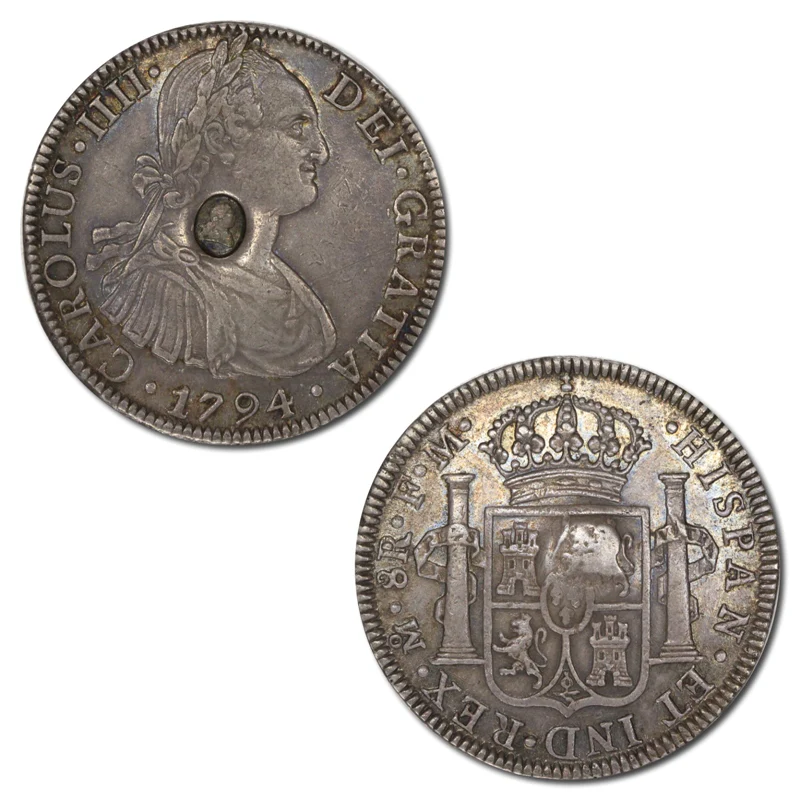
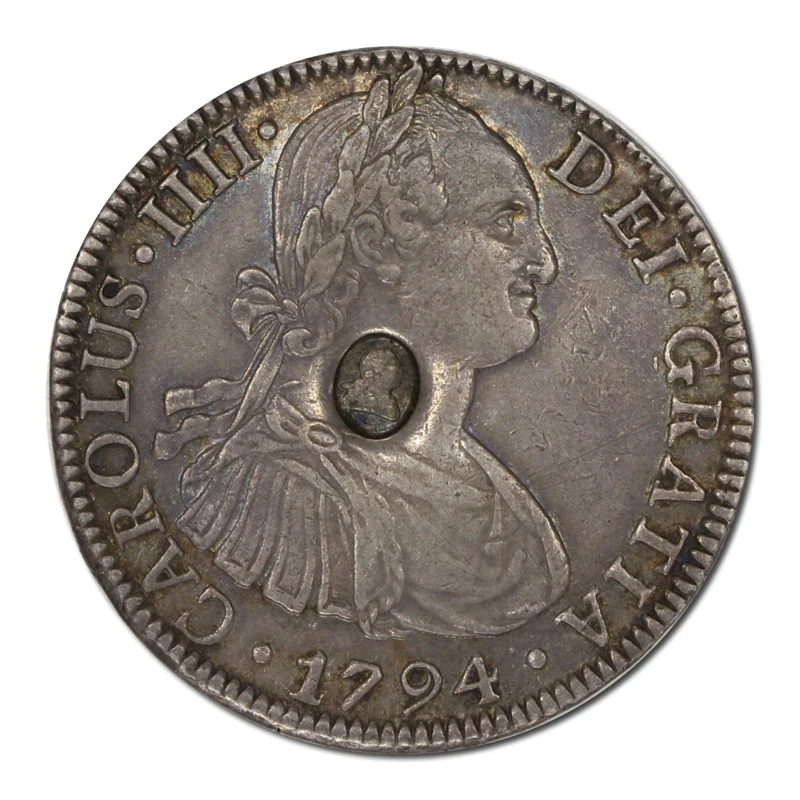
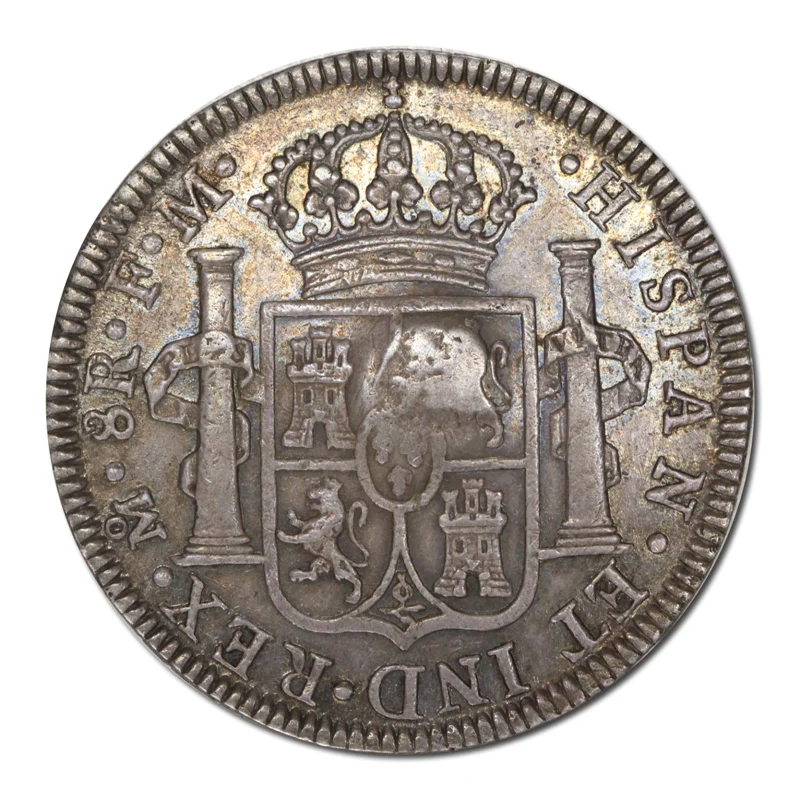
Great Britain (1797) $1 Counterstamp on Charles IIII 1794 8 Reales
(1797) $1 Oval Counterstamp on Charles IIII 1794 F.M Silver 8 Reales S.3765a
Host/Matrix=nEF Counterstamp=EF
For quite a number of years during the early part of King George III's reign there were no silver half crowns and crowns struck because of a shortage of the metal. A large number of captured Spanish American silver Half Dollars and Dollars (4 & 8 Reales) were available and were being unofficially used as currency. It was decided by the mint in 1797 to Countermark (C/M) the obverse of each with an oval stamp featuring the head of George III with a nominal value of 4 shillings and ninepence.
A couple of sayings that the product depicted "The head of a fool on the neck of an ass" and "Two King's heads are not worth a crown".
It soon became apparent large quantities of coins bearing forged C/M's were in circulation. The C/M's shape and size were altered around 1804 and the obverse featured an octagonal counterstamp with a larger head of the King similar to those on the silver Maundy Penny. Both the $1/2's and $1's were to be known as emergency coinage with the host coin being struck from various Spanish American mints.
Product Information
Product Information
Shipping & Returns
Shipping & Returns
Description
(1797) $1 Oval Counterstamp on Charles IIII 1794 F.M Silver 8 Reales S.3765a
Host/Matrix=nEF Counterstamp=EF
For quite a number of years during the early part of King George III's reign there were no silver half crowns and crowns struck because of a shortage of the metal. A large number of captured Spanish American silver Half Dollars and Dollars (4 & 8 Reales) were available and were being unofficially used as currency. It was decided by the mint in 1797 to Countermark (C/M) the obverse of each with an oval stamp featuring the head of George III with a nominal value of 4 shillings and ninepence.
A couple of sayings that the product depicted "The head of a fool on the neck of an ass" and "Two King's heads are not worth a crown".
It soon became apparent large quantities of coins bearing forged C/M's were in circulation. The C/M's shape and size were altered around 1804 and the obverse featured an octagonal counterstamp with a larger head of the King similar to those on the silver Maundy Penny. Both the $1/2's and $1's were to be known as emergency coinage with the host coin being struck from various Spanish American mints.